March 2026
A Sample ML Note With Rich Sections
A sample article showing how one post can combine clear writing, code, math, and visuals without losing structure.
Frame one question clearly
The strongest technical notes usually begin with one clear question. Instead of trying to explain an entire topic at once, it is more useful to narrow the scope and make one idea easy to follow.
- What exactly am I trying to understand?
- What example or experiment makes it concrete?
- What changed in my understanding after working through it?
Show the core idea through a simple formula
A good math section should make the idea clearer, not heavier. In a technical article, one small formula is often enough to show what is being measured or optimized.
Loss function example
L = 1/N * sum_(i=1)^N (y_i - yhat_i)^2
This says: compare each prediction with the target value, measure the error across the dataset, and reduce that error over time.
That is usually enough for a blog post. The goal is not to prove every detail, but to give the reader an intuitive understanding of what the model is trying to improve.
Make the idea concrete in code
Code helps when the concept becomes clearer through implementation. Even a very small snippet can turn an abstract explanation into something practical and memorable.
loss = model(batch_x, batch_y)loss.backward()optimizer.step()optimizer.zero_grad()Use visuals for flow and structure
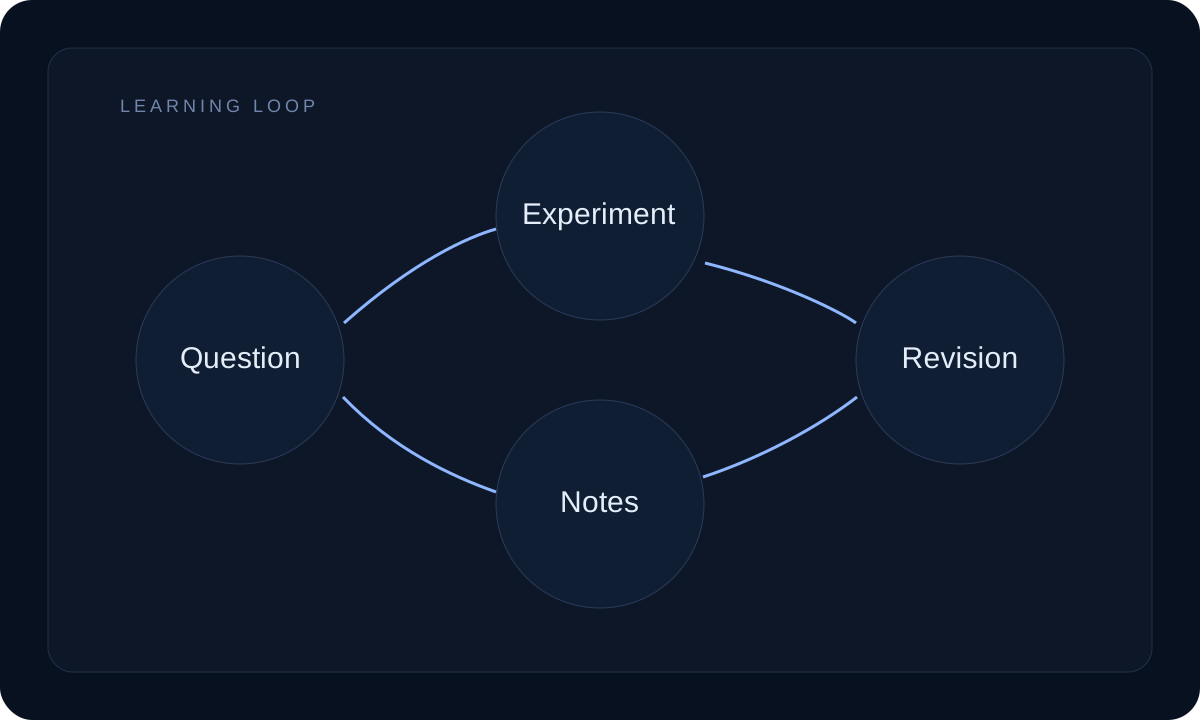
Images are most useful when the relationship between steps matters more than the detail inside one step. A loop, pipeline, or system diagram can make structure visible very quickly.
A format that stays useful later
A structured post format is easier to write, easier to revisit, and easier to expand later. It gives room for explanation, evidence, examples, and reflection without turning the article into a wall of text.
- Paragraphs for context and reasoning.
- Math blocks for core concepts and notation.
- Code blocks for implementation details.
- Images for systems, loops, and architecture views.
Continue
Read more notes or start a conversation.
If this article was useful, you can explore more writing on engineering and AI/ML, or reach out directly through the contact page.